Sunday, October 07, 2007


Thursday, October 04, 2007
Chang Bai Shan (If only I had pictures ...)
In a third-floor internet cafe in Erdao/Baihe, the two sister citites at the northern foot of the Changbai Mountains. Cigarettes on an ash-ridden floor, horns honking faintly outside, a warm glow from a pleasant walk in a beautiful sculpture-filled autumnal-leaved park, a feeling of contentment and happienss. It's been a fantastic trip, made all the better with friends to share it all with.
Yesterday was a full day on the mountainside, up early for a busride at half past six, on the mountain near seven, arriving at the fog-shrowded summit soon afterward. Thick fog, heavy with moisture and cold, thin air, perched along the very edge of the mountain, looking down into the unknown abyss and searching, for any sign, of the TianChi ("Heaven Lake") and rock below. Suddenly the wind changed, and if you looked hard enough, you saw a slight glimmer of pearl-blue water, a shoreline so thin and pure you could see the rocky ground delve into the water and then sharply plummet, dropping like the rim of a giant bowl, into the volcanic crater below.
The wind continued to change. Slowly the fog peeled back, and as more and more of the lake was revealed, the crowd on the mountainside thundered, cheering nature on. Like a rockstar coming on stage, the entire process of the lifting of the fog was a moment, a show worth experienceing, and more rewarding than simply coming upon the lake and seeing it in its simply, enourmous beauty. We all watched and yelled together as the final whisps of fog burned off, and as the last finger of cloud lifted away, mad cheering erupted as the lake was revealed in all its glory, the water a kind of blue you think of in cartoons, the blue all water should be, with sun-warmed rock and gray-white mountains in the distance, a colossus of beauty and nature standing silently before us.
Truly beautiful. What traveling should be. The mountain view on the lake was worth the trip alone. If only I could upload pictures ...
Tomorrow will be a traveling day, back to Yanji, then back to Jilin. In Yanji I took a bus to Tumen, and stood mere yards away from North Korea. At night, Tumen had lights and karoke and life along the river, while the entirety of North Korea was black. A border, and arbitrary line that in this part of the world just happens to be drawn down this thin muddy river, creating a duality that it's hard to even imagine.
When I'm back in Jilin, I'll tell (and show) more.
Friday, September 28, 2007
It's Certainly Been a Year
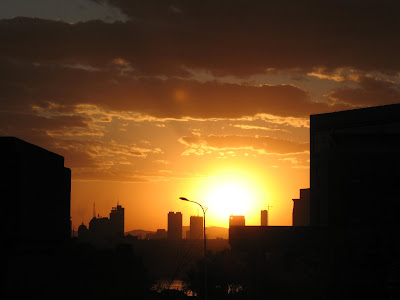
First, a glimpse of a Jilin sunset:
I was sitting in class this morning, tying to burn that damn Chinese language into my mind, half-thinking about the classes I was giving that afternoon, my mind returning to Tuesday's Mid-Autumn Festival potluck and jumping forward to the upcoming week-long National Day Holiday (week long National Day holiday? My kind of day!), when a strange series of thoughts struck me. I thought of this time last year, in Zhanjiang, when everything was new and fascinating, when I was going to Macau on my own and braving the wilds of solo travel for the first time, when teaching was just beginning to feel less like building a house during an earthquake while the wood's on fire. It's been a year, and my frame of reference, for the first time, is where I was this time last year in China, what I was doing this time last year in China. It slackens those threads of disconnect from home and winds tighter the knot of experience and living that is life, individuality.
It was a strange thought to mull over at 9:23 in the morning.
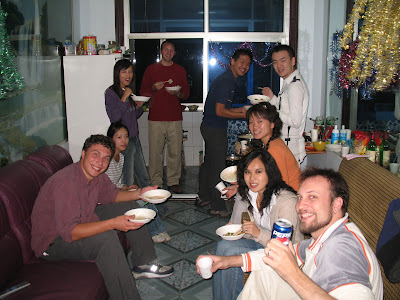
The Good and the Weird at our Mid-Autumn Potluck.
Tomorrow I begin my holiday travels. (I, but really, we: Kevin, James and myself, to be joined later by Jim and some friends from Jilin.) I will be leaving for Yanji, a small town in the far northeast of China. In Yanji is a strange mix of China and Korea, a blurring of culture and language and heritage, as well as a lot of wilderness to see and hike through in addition to a Korean Autonomous Prefecture to visit. The weather is brisk, but just warm enough to see the final lingering green of a fast-fading summer.
After a few days in Yanji, I'll (we'll) be heading southwest to the Changbai Mountains, a beautiful volcanic lake tucked within a broad range of "forever white" snow-capped peaks. This lake also happens to lap at the North Korean border, but don't worry (ahem, Dad): the Changbai Mountains are a popular (read: safe) tourist destination, and there's no way in hell I'd deliberately go to North Korea.
So I'll be out of touch for a few days. No news is good news, etc.
I'll leave you with some unfortunate frogs that were on the Mid-Autumn menu.
I was sitting in class this morning, tying to burn that damn Chinese language into my mind, half-thinking about the classes I was giving that afternoon, my mind returning to Tuesday's Mid-Autumn Festival potluck and jumping forward to the upcoming week-long National Day Holiday (week long National Day holiday? My kind of day!), when a strange series of thoughts struck me. I thought of this time last year, in Zhanjiang, when everything was new and fascinating, when I was going to Macau on my own and braving the wilds of solo travel for the first time, when teaching was just beginning to feel less like building a house during an earthquake while the wood's on fire. It's been a year, and my frame of reference, for the first time, is where I was this time last year in China, what I was doing this time last year in China. It slackens those threads of disconnect from home and winds tighter the knot of experience and living that is life, individuality.
It was a strange thought to mull over at 9:23 in the morning.
The Good and the Weird at our Mid-Autumn Potluck.
Tomorrow I begin my holiday travels. (I, but really, we: Kevin, James and myself, to be joined later by Jim and some friends from Jilin.) I will be leaving for Yanji, a small town in the far northeast of China. In Yanji is a strange mix of China and Korea, a blurring of culture and language and heritage, as well as a lot of wilderness to see and hike through in addition to a Korean Autonomous Prefecture to visit. The weather is brisk, but just warm enough to see the final lingering green of a fast-fading summer.
After a few days in Yanji, I'll (we'll) be heading southwest to the Changbai Mountains, a beautiful volcanic lake tucked within a broad range of "forever white" snow-capped peaks. This lake also happens to lap at the North Korean border, but don't worry (ahem, Dad): the Changbai Mountains are a popular (read: safe) tourist destination, and there's no way in hell I'd deliberately go to North Korea.
So I'll be out of touch for a few days. No news is good news, etc.
I'll leave you with some unfortunate frogs that were on the Mid-Autumn menu.
Wednesday, September 26, 2007
Happy Mid-Autumn Festival
Tuesday, September 25 was the Chinese Mid-Autumn Day. I was invited to a potluck at my friend's house, and James, Kevin, and I all cooked. I made some garlic mashed potatoes, James made a spicy curry, and Kevin made some pasta salad. It was a good night, a good way to celebrate this strange lunar holiday, even if I did so with more foreigners than Chinese.
My classes have been going very well. My freshmen are all very wide-eyed and eager to learn. I think their reluctance to speak in class doesn't accurately reflect their true level, because when pushed, they speak quite well. But in just these past few days, things have already changed, from me prodding them out of silence to having to raise my voice to get them to quiet down. It must be a shock to their little systems to have a class where they're encouraged to talk, discuss, and actually speak the language they have been learning all these years.
My students, I was surprised to learn, knew surprisingly few English words that English speakers use all the time to talk about China. They knew words like moon cake (the traditional food of the Mid-Autumn Festival, ranges from tasty to awful, like fruitcake at Christmas) and phrases like "Mid-Autumn Day Festival," but they didn't know that their native language, Pǔtōnghuà, is called Mandarin in English. One of the first things I learned in Chinese, even wanted to learn, was how to refer to my country and my language. And it seems for every word I say, there is a muttered wave echoing its Chinese equivalent throughout the classroom. Which isn't bad, I do that with Chinese all the time, it's just ... strange, and new.
But I have been able to toss out some awesome English names. Cousins, like Brianna, Grace, Nicole, friends like Phelan and Cecilia, but also ones that are a little more weirdly me: Revan, Harmony, Prism, Sapphire, and Hymn.
Oh, and of course: Zelda.
Wednesday, September 19, 2007
Environmental Problems
There is an excellent multi-part article up over at the New York Times about the staggering effects of pollution and environmental degradation in China, and rather importantly, the apathetic and often downright antipathetic politicians that perpetuate these problems.
A lot of it can be tied back to Den Xiaoping's "growth at all costs" measures from the late 1970s and 1980s, a mentality that continues unabated today without strong rhetoric to combat it. When the country put all its faith in growth, anything to the contrary was anathema, and now there seems to be no clear voice, no decisive action, no compelling counter-argument, coming from Beijing.
What's fueled this growth, and the subsequent whole-scale rape of the environment? Well, among many other things, it's been cheap, dirty power plants that keep the lights on around China. And what fuels those power plants? Tons and tons of coal.
Think about this. Think of the fouled water used for cleaning and maintaining these power plants. Think of the myriad regulations in place in the United States, regulations that simply don't exist in China, that prevent that water from entering the groundwater, that punish the owners of these plants, that force them to have some semblance of responsibility.
Now think about the marathon runner that will be running for his country in Beijing in the summer of 2008, where the air will be polluted not only beyond the normal levels of pollution in his or her home country, but polluted three to four times beyond the hazardous level in their home country.
I'm at a loss for commentary here ... just read the article.
"Provincial officials, who enjoy substantial autonomy, often ignore environmental edicts, helping to reopen mines or factories closed by central authorities. Over all, enforcement is often tinged with corruption. This spring, officials in Yunnan Province in southern China beautified Laoshou Mountain, which had been used as a quarry, by spraying green paint over acres of rock."
A lot of it can be tied back to Den Xiaoping's "growth at all costs" measures from the late 1970s and 1980s, a mentality that continues unabated today without strong rhetoric to combat it. When the country put all its faith in growth, anything to the contrary was anathema, and now there seems to be no clear voice, no decisive action, no compelling counter-argument, coming from Beijing.
One major pollutant contributing to China’s bad air is particulate matter, which includes concentrations of fine dust, soot and aerosol particles less than 10 microns in diameter (known as PM 10).
The level of such particulates is measured in micrograms per cubic meter of air. The European Union stipulates that any reading above 40 micrograms is unsafe. The United States allows 50. In 2006, Beijing’s average PM 10 level was 141, according to the Chinese National Bureau of Statistics.
What's fueled this growth, and the subsequent whole-scale rape of the environment? Well, among many other things, it's been cheap, dirty power plants that keep the lights on around China. And what fuels those power plants? Tons and tons of coal.
All these new buildings require China to build power plants, which it has been doing prodigiously. In 2005 alone, China added 66 gigawatts of electricity to its power grid, about as much power as Britain generates in a year. Last year, it added an additional 102 gigawatts, as much as France.
That increase has come almost entirely from small- and medium-size coal-fired power plants that were built quickly and inexpensively. Only a few of them use modern, combined-cycle turbines, which increase efficiency ...
Think about this. Think of the fouled water used for cleaning and maintaining these power plants. Think of the myriad regulations in place in the United States, regulations that simply don't exist in China, that prevent that water from entering the groundwater, that punish the owners of these plants, that force them to have some semblance of responsibility.
Now think about the marathon runner that will be running for his country in Beijing in the summer of 2008, where the air will be polluted not only beyond the normal levels of pollution in his or her home country, but polluted three to four times beyond the hazardous level in their home country.
I'm at a loss for commentary here ... just read the article.
Tuesday, September 18, 2007
普通話 (Pǔtōnghuà) Means the Common Speach
And boy is that right.
Tonight my friend Joo ("Joe," as in Schmoe) invited a few friends around to his uncle's place in the middle of the city. Joo is Korean, and his "uncle" is really just a close friend of the family, but Joo saves money on room and board while he attends Beihua's foreign language school by living there. It's a short ten minute/thirteen kuai cab ride from campus, and it's a welcome change of scenery.
We were having a "pot luck" dinner, so everyone had to bring something to eat. I didn't have time/any ability to cook, so James and I stopped by a jiaozi restaurant on our way there to buy a few dozen dumplings to bring with us. I ran into two of my classmates (also both Korean) from "qu ji er ban"/class two, and through broken Chinese, body language, and random (but necessary) English exclamations, I was able to invite them along. It was a short walk from the restaurant to Joo's, and when we got there, it was surreal.
Joo had some Korean friends, but also there was Wakana (one of the Japanese teachers), as well as James, Kevin, and myself. For once, English was not the common tongue, and we all had to push ourselves to communicate with Chinese. And it was great. Long-dormant vocabulary and speech patterns sprang to mind, forgotten verbs and phrases dusted off the cobwebs, and with just enough English to get over the big humps of understanding, we had a great time.
Playing an American drinking game (One Up, One Down), drinking Korean soju, counting off and talking in Chinese ... it was fantastically bizarre.
Sunday, September 16, 2007
Caffeinated Irony
Leave it to me to come to China to discover fantastic coffee.
China's store-bought coffee is instant coffee. As in, add water, stir, and you get some offensively bilious garbage that only a desperate fool would call coffee.
This will not do.
So when fortune smiled upon me and delivered unto me a coffee machine along with my new place in Jilin (despite the one I had in storage in Hong Kong that is as we speak (type?) en route), I decided I needed to find a source for ground coffee.
Once again, I was luckier than I was in Zhanjiang, because the local markets around here actually have import sections, containing a limited but certainly acceptable variety of ground coffee to any caffeinistas out there.
But then I walked by a little coffee shop near the Da Fuyuan market (I know, the 'ol mom and pop's Da Fuyuan), when what to my shimmering coffee-obsessed eye did appear, but a miniature grinder and bags of coffee beans, oh dear! Yes, the store carried whole-roasted coffee beans, bean grinders, bean roasters, and all sorts of coffee-brewing paraphernalia. You could even buy green coffee beans, roast them yourself at home, and then grind them at home for the ultimate in fresh coffee. That may be the next step, but I digress.
No, seriously, I do. Watch.
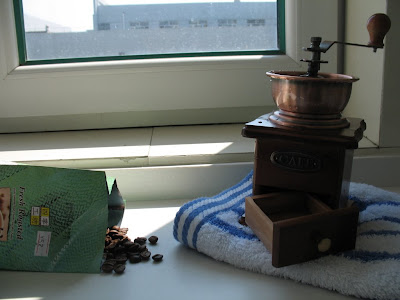
So I bought myself a small, hand-powered coffee grinder, and a little sack of Columbian beans. (See? Digression.) I brought that sucker home and got to work, and brewed myself a few cups of amazingly good coffee. It's unlike any coffee I've had before: upon brewing, the pot shimmers a beautiful warm ruby, the aroma is a dry muskiness from the freshly-crushed beans, and the taste is a sharp, delicious jolt lacking the bitterness of freeze-dried and even industrially-ground coffee. It's a satisfying sip, too, because you're actually tasting the freshly-cut, freshly-brewed bean.
So it's sadly ironic that I travel to the opposite (new word: antipodean) side of the planet, the veritable tea capital of the world, and indulge in coffee. But hey, the two are not mutually exclusive, and I'm buying and enjoying all kinds of great tea as well.
I can't believe how much I write about beverages. Good lord.
China's store-bought coffee is instant coffee. As in, add water, stir, and you get some offensively bilious garbage that only a desperate fool would call coffee.
This will not do.
So when fortune smiled upon me and delivered unto me a coffee machine along with my new place in Jilin (despite the one I had in storage in Hong Kong that is as we speak (type?) en route), I decided I needed to find a source for ground coffee.
Once again, I was luckier than I was in Zhanjiang, because the local markets around here actually have import sections, containing a limited but certainly acceptable variety of ground coffee to any caffeinistas out there.
But then I walked by a little coffee shop near the Da Fuyuan market (I know, the 'ol mom and pop's Da Fuyuan), when what to my shimmering coffee-obsessed eye did appear, but a miniature grinder and bags of coffee beans, oh dear! Yes, the store carried whole-roasted coffee beans, bean grinders, bean roasters, and all sorts of coffee-brewing paraphernalia. You could even buy green coffee beans, roast them yourself at home, and then grind them at home for the ultimate in fresh coffee. That may be the next step, but I digress.
No, seriously, I do. Watch.
So I bought myself a small, hand-powered coffee grinder, and a little sack of Columbian beans. (See? Digression.) I brought that sucker home and got to work, and brewed myself a few cups of amazingly good coffee. It's unlike any coffee I've had before: upon brewing, the pot shimmers a beautiful warm ruby, the aroma is a dry muskiness from the freshly-crushed beans, and the taste is a sharp, delicious jolt lacking the bitterness of freeze-dried and even industrially-ground coffee. It's a satisfying sip, too, because you're actually tasting the freshly-cut, freshly-brewed bean.
So it's sadly ironic that I travel to the opposite (new word: antipodean) side of the planet, the veritable tea capital of the world, and indulge in coffee. But hey, the two are not mutually exclusive, and I'm buying and enjoying all kinds of great tea as well.
I can't believe how much I write about beverages. Good lord.
Subscribe to:
Posts (Atom)




